

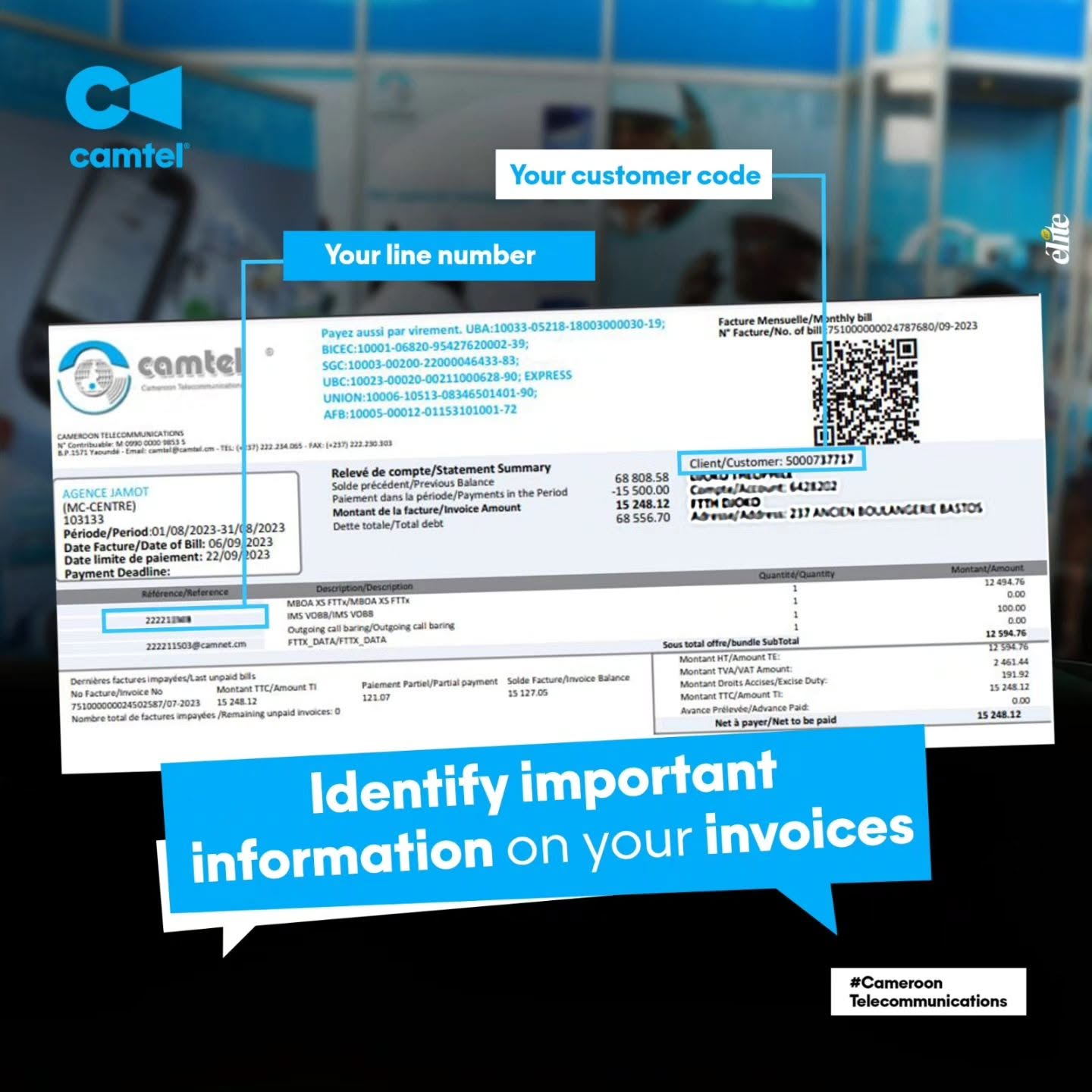

An invoice isn't just a piece of paper you hand to a customer to get paid. In Cameroon, it's a tax document: it proves your revenue, determines the VAT you must pay to the State, and conditions your customer's right to deduct their expenses and VAT. A poorly drafted invoice therefore doesn't create one problem, but three: for you, for your customer, and at the next audit.
Many Cameroonian SMEs learn this the hard way: a missing NIU, a wrong VAT rate, numbering that skips, and the result is a reassessment with penalties - sometimes years after the fact.
This guide covers everything: the details to include, 19.25% VAT explained simply, an annotated invoice template, the 9 mistakes that lead to a reassessment, and what changes with the e-invoicing introduced by the 2026 finance law.
⚠️ Disclaimer: this article is a practical guide, not legal or tax advice. Regulations change every year with the finance law. For a specific situation, check the official website of the Directorate General of Taxes (impots.cm), call the DGI call centre (toll-free number 8200) or consult your accountant or tax adviser.
Why invoice compliance has become critical
The invoice is the basis of every VAT audit
VAT is collected by businesses on behalf of the State. When the tax authority audits your VAT, it starts from your sales invoices (output VAT) and your purchase invoices (input VAT). Every irregular invoice is a potential reassessment line.
Your customer needs YOUR compliant invoice
This is the point many suppliers overlook: if your invoice is irregular, your customer pays the price too. Since the 2012 finance law, the tax authority has set a very clear rule: expenses recorded on an invoice that doesn't show the supplier's NIU are not deductible, and the presence of the NIU is even the precondition for any examination of deductibility (implementing circular for the 2012 finance law).
The direct commercial consequence: serious companies - and even more so large companies and public administrations - reject or block non-compliant invoices. An irregular invoice means a delayed payment.
The tax administration is going digital at high speed
E-filing, a new registration system, e-invoicing: the DGI increasingly cross-checks its data. Inconsistencies between your invoices and your returns, once invisible, are becoming automatically detectable. We cover this in detail below.
Who must charge VAT (and who absolutely must not)
Before looking at the details, a preliminary question: are you allowed to charge VAT?
According to the DGI, businesses subject to VAT include those with annual revenue of 50 million FCFA or more, as well as certain sectors automatically placed under the real regime (oil, gas, mining, banking, telecoms, insurance and microfinance, public procurement, etc.).
Below this threshold, businesses under the flat-rate tax (impôt libératoire) or the basic regime do not, in principle, charge VAT (voluntary opting in is possible in some cases, to be confirmed with your tax centre). This guide by LeFisk on business taxation in Cameroon details the 4 regimes and their thresholds.
Remember: charging VAT when you're not authorised to is a serious mistake, not a "little extra" to look more professional. We'll find it again in the list of mistakes.
Mandatory details on an invoice in Cameroon
The DGI summarises the obligation as follows: businesses subject to VAT must issue compliant invoices, including in particular the identification of the parties, the price excluding tax, and the VAT rate and amount (official DGI VAT factsheet). In practice, a professional invoice that holds up in an audit includes the elements below.
1. Full identification of the supplier (you)
- Company name or trade name, and legal form (SARL, SA, Ets...)
- Full address (city, district, PO box)
- NIU (Unique Identification Number) - the most critical detail on the entire invoice
- RCCM number (Trade and Personal Property Credit Register) - strongly recommended and expected by business customers
- Tax regime and tax centre of attachment - common details in Cameroon that make it easier for your customers to run checks
- Contact details: phone, email
2. Identification of the customer
- Name or company name, address
- Customer's NIU when the customer is a business: essential in B2B, in particular so that your customer can exercise their right to deduct
3. Invoice references
- The word "Invoice" clearly visible (not to be confused with a quote or a pro forma invoice, which have no tax value as a sale)
- A unique number, from a continuous chronological sequence, with no gaps or duplicates
- The date of issue
4. Details of the transactions
- Precise description of each good or service (no "Miscellaneous" or "Service" without details)
- Quantity and unit price excluding tax
- Any discounts, rebates or early-payment discounts granted
- The total amount excluding tax
5. VAT and total
- The VAT rate applied: 19.25% at the standard rate
- The VAT amount, separate and clearly shown
- The amount including tax
- For an exempt or zero-rated transaction (export): a statement of the exemption and its legal basis, instead of VAT
6. Payment terms (recommended)
- Due date and payment method (bank transfer, MTN MoMo, Orange Money, cheque...)
- Bank details if paying by transfer
💡 The right reflex: if you're unsure about a detail specific to your business (excise duties, exempt transactions, public contracts), have your invoice template validated once and for all by your accountant. After that, your software should apply it automatically on every invoice.
19.25% VAT explained simply
Where does this rate come from?
The standard VAT rate in Cameroon is 19.25%: it's a rate of 17.5% plus 10% municipal additional centimes (CAC) (10% of 17.5% = 1.75 points). There is also a zero rate for exports. Source: DGI, VAT factsheet.
The calculation, with an example
For a service of 1,000,000 FCFA excluding tax:
| Line | Amount |
|---|---|
| Total excl. tax | 1,000,000 FCFA |
| VAT 19.25% | 192,500 FCFA |
| Total incl. tax | 1,192,500 FCFA |
And to find the VAT from a price including tax: VAT = price incl. tax ÷ 1.1925 × 0.1925. Example: on 596,250 FCFA including tax, the VAT is 96,250 FCFA and the price excluding tax is 500,000 FCFA.
When does VAT become due?
According to the DGI: on delivery for sales of goods, and on receipt of payment for services. This detail matters: a service provider who invoices in December but is paid in January declares the VAT in January.
Filing and payment
VAT returns are monthly, to be filed before the 15th of the following month. Our recommended external resource for the step-by-step procedure: the guide to filing VAT on Fiscalis by LeFisk.
Watch out for withholding at source
Some customers - notably the State and public bodies, as well as certain designated companies - apply VAT withholding at source: they pay you the amount excluding tax (minus any tax instalments) and pay the VAT to the Treasury themselves. Your invoice must then show the amount excluding tax and the VAT very distinctly, otherwise it will be rejected by the expenditure control departments. The principle is described in this MINFI circular on withholding at source; as the instalment rates have changed since, check the current values with your accountant.
Annotated compliant invoice template
┌─────────────────────────────────────────────────────────────┐ │ ETS KAMGA DISTRIBUTION SARL INVOICE │ │ Akwa, Douala - PO Box 1234 No. 2026-0418 │ ← continuous sequence │ NIU: M0XXXXXXXXXXXX RCCM: RC/DLA/20XX/B/XXXX │ ← mandatory NIU │ Regime: Real - CIME Douala Tel: 6XX XX XX XX │ ← customary details │ Date: 08/10/2026 │ ├─────────────────────────────────────────────────────────────┤ │ CUSTOMER: SOCIÉTÉ BELLE VUE SA - Bonapriso, Douala │ │ Customer NIU: P0XXXXXXXXXXXX │ ← customer NIU (B2B) ├──────────────────────────┬──────┬──────────────┬────────────┤ │ Description │ Qty │ Unit excl. │ Total excl.│ ├──────────────────────────┼──────┼──────────────┼────────────┤ │ Case of 1.5L water │ 200 │ 2,500 │ 500,000 │ ← precise description │ Delivery to Bonapriso │ 1 │ 25,000 │ 25,000 │ │ Trade discount 5% │ │ │ -26,250 │ ← visible discount ├──────────────────────────┴──────┴──────────────┼────────────┤ │ TOTAL EXCL. TAX │ 498,750 │ │ VAT 19.25% │ 96,009 │ ← rate + amount │ TOTAL INCL. TAX │ 594,759 │ ├────────────────────────────────────────────────┴────────────┤ │ Due: 30 days - Payment: bank transfer or MTN MoMo │ └─────────────────────────────────────────────────────────────┘
The NIU and RCCM numbers above are fictitious. VAT amounts are rounded to the nearest franc.
The 9 mistakes that lead to a tax reassessment
Mistake 1: a missing, incomplete or incorrect NIU
This is the number one mistake. Without the supplier's NIU, the expense isn't deductible for your customer, and neither is the VAT. If your customer is audited, your invoices will be rejected - and they'll turn to you. Also check your suppliers' NIU: a purchase invoice without a valid NIU makes you lose your own deductions.
Mistake 2: charging VAT without being authorised to
A business under the flat-rate tax or the basic regime that adds "VAT 19.25%" to its invoices to look more established puts itself in an irregular position: the VAT charged is owed to the Treasury, and the customer won't be able to deduct it. A thesis on withholding tax in Cameroon also points out that suppliers under these regimes are not authorised by law to charge VAT (source).
Mistake 3: the wrong VAT rate
18%, 17.5% without the CAC, 20% inherited from a French invoice template... Each variant produces incorrect VAT on all your invoices, and therefore systematic discrepancies. The standard rate is 19.25%, full stop.
Mistake 4: VAT not shown separately (price "incl. tax" only)
An invoice that shows a single price without separating the amount excluding tax and the VAT is irregular. The customer can't deduct VAT they can't see, and the tax authority may treat the price as including tax and extract the VAT from it - to your detriment.
Mistake 5: numbering that skips, repeats or restarts from zero
Gaps in the sequence ("where did invoice 0412 go?"), duplicates or numbering per salesperson are classic red flags in an audit: they suggest concealed sales. With Word or Excel, it's the most common mistake - everyone types their number by hand.
Mistake 6: editing or deleting an invoice instead of issuing a credit note
An issued invoice is never edited or deleted. In the event of an error, a return or a discount granted afterwards, you issue a credit note that references the original invoice. Reopening the Word file to "correct" an invoice that has already been sent is exactly what makes your accounts indefensible.
Mistake 7: cash payments above 100,000 FCFA
On the purchasing side, the DGI sets a condition for deducting VAT: you must not have paid in cash above 100,000 FCFA, and no VAT credit refund is allowed on the basis of invoices paid in cash (DGI). For large purchases: bank transfer, cheque or traceable payment.
Mistake 8: invoices that don't match your returns
The total of your invoices for the month must match the output VAT declared on Fiscalis. Sales invoiced but not declared, "rounded" returns, VAT on services declared in the wrong month (forgetting the payment-receipt rule): these discrepancies are precisely what the DGI's data cross-checking brings to light.
Mistake 9: not keeping your invoices long enough
Accounting and tax documents must be kept for 10 years (General Tax Code and OHADA Uniform Act, as LeFisk points out). A damaged binder, a stolen computer, an overwritten file - and you can no longer justify your deductions. Backed-up digital archiving is no longer a luxury.
E-invoicing: what the 2026 finance law changes
This is the major tax project of the moment. The 2026 finance law introduces an e-invoicing system, initially for certain transactions subject to VAT, mainly between businesses (B2B). It relies on a continuous transaction control model: invoices are issued in a structured electronic format and transmitted to or validated by a tax administration platform, in real time or near real time. The rollout is announced as gradual, probably by category of taxpayer, using approved technology providers (EDICOM analysis, April 2026).
A clear sign of the direction being taken: the DGI's VAT factsheet now makes VAT deduction conditional on compliant invoices generated from the tax administration's invoicing system.
What this means in practice for an SME:
- Invoices made in Word or Excel have no future: they are neither structured, nor transmittable, nor traceable.
- Your invoicing tool will need to produce structured data and, depending on your category, connect with the administration's platform or an approved provider.
- Automatic cross-checking of invoices issued and received will make mistakes 5 and 8 instantly detectable.
⚠️ The technical arrangements and the timetable for each category of business are being specified gradually by the administration. Before making any decision, check your exact situation on impots.cm or via the toll-free number 8200. Also note that tax registration (obtaining your NIU) has moved to the ATOM platform: LeFisk's ATOM guide.
How invoicing software eliminates these mistakes
Let's go back to the list: of the 9 mistakes, 7 are manual entry errors that properly configured invoicing software simply makes impossible:
| Mistake | What the software does |
|---|---|
| Missing or wrong NIU | Your legal details are pre-filled on every invoice; the customer's NIU is recorded once in their profile |
| Wrong VAT rate | The 19.25% rate is set once, applied everywhere, and updated centrally if the law changes |
| VAT not shown separately | Amounts excluding tax, VAT and including tax are calculated and displayed automatically |
| Broken numbering | Automatic chronological numbering that can't skip or duplicate |
| Edited invoice | Validated invoices are locked; corrections go through a linked credit note |
| Discrepancy with the return | The monthly output VAT summary is produced in one click, ready for Fiscalis |
| Record keeping | Backed-up digital archiving, retrievable in seconds for 10 years |
That leaves two decision mistakes (charging VAT without authorisation, paying cash above the threshold): there, your accountant protects you - but the software can alert you.
If you still invoice in Word or Excel, our article Managing your business with Excel: why it always ends up costing you puts a figure on what that choice really costs you.
How to choose compliant invoicing software
Four questions to ask any supplier during a demo:
- "Show me an invoice generated by your tool." It must show the NIU, Cameroonian legal details and 19.25% VAT - not a SIRET number or 20% VAT.
- "Can a validated invoice be edited?" The right answer is no: you go through a credit note.
- "How do you produce my VAT for the month?" You need a summary that can be used directly for the return.
- "Are you ready for the e-invoicing introduced by the 2026 finance law?" Insist on a precise answer: structured data, integration capability, commitment to updates.
To compare the solutions on the market, see our comparison of the 7 best sales management software in Cameroon, our guide to management software prices in FCFA, and our complete guide to choosing well.
FAQ
Is the NIU mandatory on all invoices? The supplier's NIU is essential: without it, your customer's expenses are not deductible. In B2B, also include your customer's NIU. Your NIU appears on your registration certificate.
What is the VAT rate in Cameroon in 2026? The standard rate is 19.25% (17.5% plus 10% municipal additional centimes). Exports are zero-rated, and certain transactions are exempt (list in article 128 of the General Tax Code).
Does a pro forma invoice have any tax value? No. A pro forma is a price offer. Only the final invoice, issued at the time of the sale or service, has tax and accounting value.
Can I correct an invoice that has already been sent? No: an issued invoice is never edited. You issue a credit note that cancels all or part of the original invoice (referencing it), then a new invoice if necessary.
How long should I keep my invoices? Ten years. Use backed-up digital archiving in addition to paper.
Does e-invoicing already apply to my SME? The rollout planned by the 2026 finance law is gradual, by category of taxpayer. Check your exact timetable with your tax centre or on impots.cm - and in any case, move away from Word and Excel now to a tool that can keep up with this change.
Conclusion: compliance is a setting, not a daily effort
A compliant invoice in Cameroon means about ten details, a VAT rate, clean numbering and one discipline: never edit, always archive. Nothing complicated in itself - the risk comes from manual repetition, invoice after invoice, month after month.
That's exactly why compliance should be configured once in a tool, then applied automatically. At Alivaon, in Douala, we develop invoicing software compliant with DGI requirements: automatic legal details, 19.25% VAT, locked numbering, linked credit notes, a monthly VAT summary, and an architecture designed to evolve with e-invoicing. Integrated if needed with your custom sales management, your stock management and your till/POS.
👉 Get your invoice templates audited for free - reply within 24 hours


Be the first to leave a comment.