

Think of your ten best customers from last year. How many came back this month? If you can't answer, you're not alone. In most Cameroonian SMEs, the "customer base" lives in three places: the manager's phone contacts, WhatsApp conversations, and the credit notebook. Nobody can say who buys what, who hasn't come back, or who was sent a quote that never got a reply.
Yet your current customers are your most valuable sales resource. They know you, they trust you, they know where to find you. Getting them to come back a little more often or buy a little more almost always costs less than finding new ones.
A CRM (customer relationship management) isn't a tool reserved for large companies. In its simple form, it's a living customer database, linked to your sales, that tells you who to follow up with, when and why.
This guide explains how to build this database, how to use it to increase your sales with six concrete actions, how to use WhatsApp without spamming, and what Cameroon's new personal data protection law changes.
What a simple CRM does (and what it doesn't)
What it does
A CRM suited to an SME answers four questions:
- Who are my customers? One profile per customer, with their contact details and history.
- What do they buy from me? Every sale and every invoice is automatically linked to the profile.
- Who needs a follow-up? Inactive customers, unanswered quotes, overdue receivables.
- What do I need to do today? A task list: call this customer, send this quote, chase this payment.
What it doesn't do
It doesn't sell for you, and it's useless if it's separate from your sales. A standalone CRM, where every purchase has to be re-entered by hand, is abandoned within weeks. The rule is simple: the customer database must be fed automatically by the till and invoicing. That's why, for an SME, the best CRM is often a module of its management software, rather than yet another tool.
Step 1: build a useful (not exhaustive) customer database
The information to collect
Collect little, but collect well. For most SMEs, this is enough:
| Information | Why |
|---|---|
| Name or company name | Identify the customer |
| Phone number (and whether it's on WhatsApp) | The main contact channel in Cameroon |
| District or city | Deliveries, rounds, local targeting |
| Customer type | Individual, reseller, business, public administration |
| NIU (for businesses) | Compliant invoicing |
| Consent to receive offers | Mandatory before any marketing (see below) |
| Special terms | Credit limit, usual discount, payment terms |
Everything else (purchase history, amount spent, last visit, receivables) isn't entered: the software calculates it from sales.
How to collect without slowing down the till
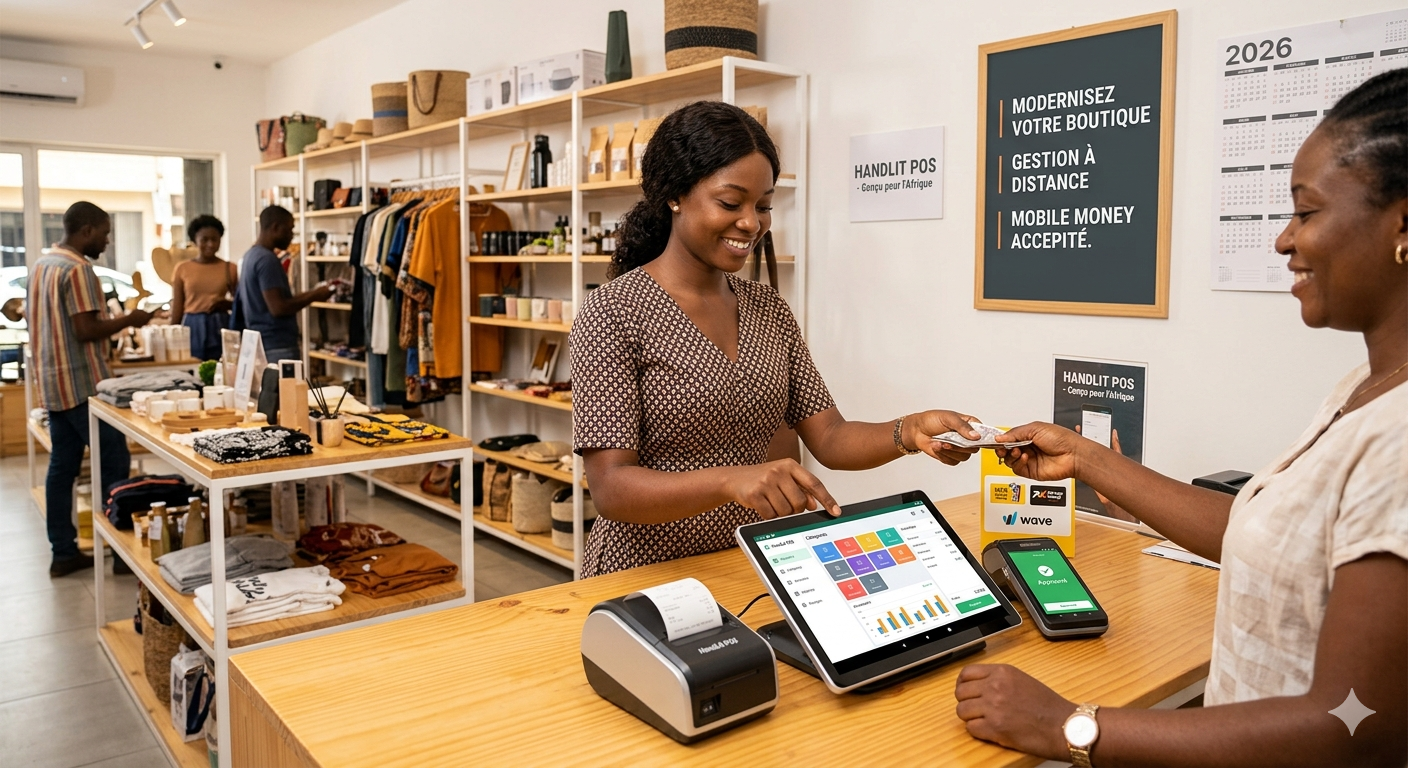
- At the till: simply ask for the phone number at checkout. It's the most practical identifier, and many customers give it willingly in exchange for a benefit (loyalty points, receipt sent by WhatsApp, news about new arrivals).
- For credit sales and business customers: the profile is essential, so always create it.
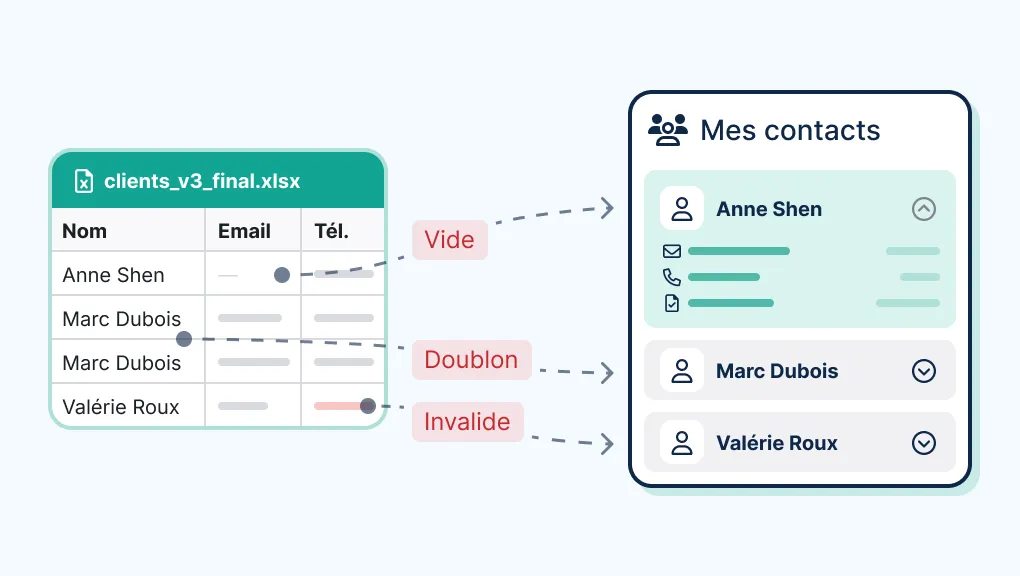
- For existing customers: go through your credit notebook, your invoices and your professional WhatsApp contacts. That's your first database.
The 3 quality rules
- One customer = one profile. Check by phone number before creating a duplicate.
- Standardised fields: the same district names, the same customer types. Otherwise, sorting is impossible.
- Updates as you go: a changed number is corrected the same day.
Step 2: segment your customers to know who to follow up with
Not all your customers deserve the same attention. A simple method, inspired by what marketers call RFM analysis (recency, frequency, monetary value), involves looking at three things:
- Recency: when did the customer last buy?
- Frequency: how many times do they buy per month or per year?
- Monetary value: how much do they spend in total?
With these three criteria, you get very telling groups:
| Group | Profile | Priority action |
|---|---|---|
| The pillars | Buy often, a lot, recently | Thank them, build loyalty, serve them first |
| The regulars | Buy often, average amounts | Offer them complementary items |
| The newcomers | Recent first or second purchase | Get them to come back a second time |
| The dormant | Used to buy regularly, nothing for 60 days or more | Win them back quickly |
| The occasional | Rare, small purchases | Light communication, without insisting |
Management software does this segmentation automatically from sales history. The most profitable group to work on is almost always the dormant customers: they already know you, and something made them leave.
Step 3: the 6 actions that really increase your sales
Action 1: win back dormant customers
Every week, the software produces the list of good customers who haven't bought anything for 60 days (or whatever period makes sense for your business). A personal call or message is often enough:
"Hello Mrs Ngo Bayiha, we haven't seen you at the shop for a while. We've received the hair extensions you usually buy. Would you like us to put some aside for you?"
If the customer replies that they've gone to a competitor because of price or service, that's valuable information.
What it can bring in: a shop with 400 regular customers often sees some of them go dormant. If out of 100 dormant customers you bring back 20, who spend 15,000 FCFA twice a month, that's 600,000 FCFA of monthly revenue recovered. These are assumptions: do the calculation with your own figures.
Action 2: follow up on unanswered quotes
A quote sent and never followed up is often a sale lost through simple oversight. The CRM sorts quotes by status and flags those that have been waiting for more than 5 to 7 days. A short follow-up, before the quote expires, is often enough to close. The details are presented in our article Invoicing software in Cameroon: automating quotes, invoices and reminders.
Action 3: turn the first purchase into a habit
A new customer who comes back a second time is much more likely to become a regular. The CRM spots new customers and lets you send them a thank-you message or a small offer valid on their next purchase.
Action 4: suggest the right complement
Purchase history tells you what the customer needs. The customer who buys cement needs reinforcing bars. The one who buys a phone needs a case and a charger. The one who buys a cream every month will be interested in the new serum from the same range. These suggestions are relevant because they're based on real purchases, not a message sent to everyone.
Action 5: get in touch at the right time
Arrival of an awaited product, an out-of-stock item back in stock, back to school, end-of-year holidays: the CRM lets you send the information only to the customers concerned. A targeted message sent to 40 customers who buy that item is far more effective than a general message sent to 400 people, most of whom aren't interested.
Action 6: track credit sales and payments
The customer profile shows the balance due, due dates and payment history. The CRM reminds you of due dates and alerts you when a customer exceeds their limit. This protects your cash flow and your relationships: you follow up at the right time, with accurate figures, rather than letting a debt pile up and the relationship deteriorate.
Business customers: tracking your opportunities
If you sell to companies, public administrations or resellers, a CRM also helps you track your sales opportunities, i.e. sales under negotiation.
Each opportunity goes through simple stages:
First contact → Need identified → Quote sent → Negotiation → Won or lost
For each one, the CRM records the estimated amount, the next action and its date. Every Monday, you see your pipeline of deals in progress and the follow-ups to do that week. And when a deal is lost, note the reason (price, lead time, competitor): after a few months, you'll know precisely why you're losing sales.
WhatsApp: your best channel, to be used with discipline
WhatsApp is the communication channel most used by customers in Cameroon. It's a strength, provided you use it properly.
Good practices
- Use a WhatsApp Business account in the company's name, on a business number, not the personal number of the manager or a salesperson. The day an employee leaves, the customers and the history stay with the company.
- Personalise your messages: the customer's first name, the item they usually buy. A message that looks like mass advertising is ignored, or worse, reported.
- Target: send an offer to the customers it concerns, not your whole contact list.
- Limit the frequency: one or two marketing messages a month are enough. Beyond that, you lose attention, then the customer.
- Respect opt-outs: a customer who asks to stop receiving messages must be removed from your sends immediately, and the opt-out recorded in their profile.
- Record important exchanges in the CRM: a promise to pay, a complaint, a special order. A WhatsApp conversation isn't a customer history.
Linking WhatsApp to your management
In well-integrated software, the customer profile lets you open a WhatsApp conversation directly, send a quote, an invoice or a reminder, and keep a record of the sending. The most advanced solutions use WhatsApp's business offering to automate certain messages: due-date reminders, order confirmations, delivery notices.
Cameroon's personal data law: what changes for your customer database
This is a point many SMEs are still unaware of. Law No. 2024/017 of 23 December 2024 on the protection of personal data came into force on 23 June 2026, after an 18-month moratorium granted to businesses and administrations (Droit Médias Finance). Your customer database is directly affected: a name, a phone number and a purchase history are personal data.
According to the summary published by this source, the key principles are:
- Consent: collection requires explicit, free and informed agreement, which can be withdrawn at any time. Pre-ticked boxes are ruled out.
- Purpose and minimisation: only collect the data needed for the intended use.
- Security: protect databases with appropriate technical measures.
- Individuals' rights: your customers can access their data, have it corrected or deleted, and object to its use for marketing.
- Penalties: breaches can lead to administrative fines, and the most serious offences (such as selling databases) to criminal penalties.
In practice, for an SME
- Ask for the customer's consent before sending them marketing offers, and record this consent in their profile (date, channel).
- Never buy or sell phone number lists. It's now a serious legal risk, as well as being ineffective.
- Only collect what's useful: no unnecessary questions about the customer's private life.
- Protect access: each employee has their own account, only sees what they need, and the database can't be exported by just anyone.
- Respond to requests: a customer who wants to view, correct or delete their data must be able to do so.
- Beware of uncontrolled copies: an Excel customer file sent by email or shared on a USB stick is a potential leak.
⚠️ This summary is a practical guide, not legal advice. Implementing texts and control arrangements are gradually specifying these obligations. For a large customer database or advanced marketing uses, have your practice validated by a lawyer.
The good news: a well-kept CRM helps you comply. Consent is recorded, opt-outs are respected automatically, access is controlled, and you know exactly what data you hold. It's the opposite of a shared phone contact list and improvised WhatsApp lists.
The indicators to track
Four indicators are enough to measure how effective your customer database is. They fit naturally into the "customers" dashboard presented in our article Sales tracking: the 5 dashboards every manager should check every week.
- The share of sales linked to an identified customer: the higher it is, the more useful your database.
- The number of active customers: those who have bought in the last 30 or 90 days.
- The rate of dormant customers won back after a follow-up.
- The quote conversion rate: quotes accepted ÷ quotes sent.
Features to demand from your CRM
- ✅ Customer profile automatically linked to sales, invoices and payments
- ✅ Search by phone number and duplicate checking
- ✅ Purchase history and total amount spent
- ✅ Automatic segmentation: active, dormant, new, pillar customers
- ✅ Quote and opportunity tracking, with follow-ups
- ✅ Balances, credit limits and due dates
- ✅ Sending by WhatsApp and SMS from the profile, with history
- ✅ Consent recording and opt-out management
- ✅ Tasks and reminders for the sales team
- ✅ Access rights by profile and controlled export
- ✅ Mobile access for field sales reps
To compare the available solutions, see our comparison of the 7 best sales management software in Cameroon. If your customer relationship has specific features (reseller network, sales rounds, in-house loyalty programme), our article custom or standard software: which should you choose? will help you decide.
The 4-week start-up plan
Week 1: gather. Bring your known customers (credit notebook, invoices, professional WhatsApp contacts) together in the software. Remove duplicates.
Week 2: collect. Ask for the number and consent to offers with every sale at the till. Set a simple target: for example, linking half of all sales to an identified customer.
Week 3: segment. Let the software segment your customers. Identify your 20 best customers and your 20 best dormant customers.
Week 4: act. Launch your first win-back campaign with the dormant customers, and follow up on all pending quotes. Measure the result.
Then: add customer follow-ups to the Monday ritual. Ten minutes, three calls, every week.
FAQ
Do you really need software, or is an Excel file enough? An Excel file can be a starting point, but it isn't linked to sales: purchase history, dormant customers and balances have to be updated by hand, which is rarely done. It's also harder to protect, which is a problem under the new personal data law.
Will my customers agree to give their number? Most will, if they see a benefit: receipt sent by WhatsApp, loyalty points, news about new arrivals, tracking their credit. Explain clearly what the number will be used for, and respect refusals.
How many marketing messages can you send? There's no universal rule, but one or two targeted messages a month are generally well received. Beyond that, customers get tired. And never send offers to someone who hasn't given their consent.
Does the personal data law also apply to small shops? It applies to any processing of personal data, so to small businesses' customer databases too. The heaviest obligations (such as appointing a data protection officer) mainly target large organisations in certain sectors, but the basic principles (consent, security, customers' rights) apply to everyone. If in doubt, consult a lawyer.
Is a CRM useful if I mostly sell over the counter to passing customers? Yes, for the share of your customers who come back. Even in a walk-in business, regular customers often account for a significant share of sales. They're the ones the database helps you keep.
Conclusion: your current customers are your best growth lever
A customer database isn't a list of numbers. It's a sales memory that tells you who's coming back, who's drifting away, who's waiting for an answer and who owes you money. Well kept, linked to your sales and used every week, it increases your sales without spending a franc more on advertising, simply by bringing back the customers you already have.
And since June 2026, it must also be kept properly, respecting your customers' data.
At Alivaon, in Douala, we build a simple CRM into our custom sales management software: customer profiles linked to sales, automatic segmentation, quote tracking, WhatsApp and SMS follow-ups, consent management and access rights. All fed by your till/POS, your DGI-compliant invoicing and your stock management.
👉 Put your customer database to work: free demo, reply within 24 hours


Be the first to leave a comment.