


Are you still managing your sales in a notebook? Are your invoices made in Word, your stock spread across three different Excel files, and does every month-end feel like a police investigation to find out where the money went?
You're not alone. That's the daily reality for the vast majority of SMEs, shops and businesses in Cameroon. And it's exactly the problem business management software is designed to solve.
But between unsuitable foreign solutions, local software of varying quality and developers promising the moon, how do you make the right choice? This complete guide gives you a clear method for choosing management software suited to Cameroonian realities: DGI compliance, Mobile Money payments, unstable connections, a budget in FCFA and teams unused to digital tools.
By the end of this article, you'll know exactly what type of solution you need, how much to budget, and which mistakes to avoid.
What exactly is business management software?
Business management software is a tool that centralises and automates the day-to-day operations of your business. Instead of juggling a sales notebook, Word invoices, an Excel stock file and your memory for customer debts, everything is brought together in a single system.
Depending on your business, it generally covers:
- Sales management: quotes, purchase orders, delivery notes, invoices
- Sales tracking: who sold what, when, at what price, with what margin
- Stock management: stock in, stock out, inventories, out-of-stock alerts
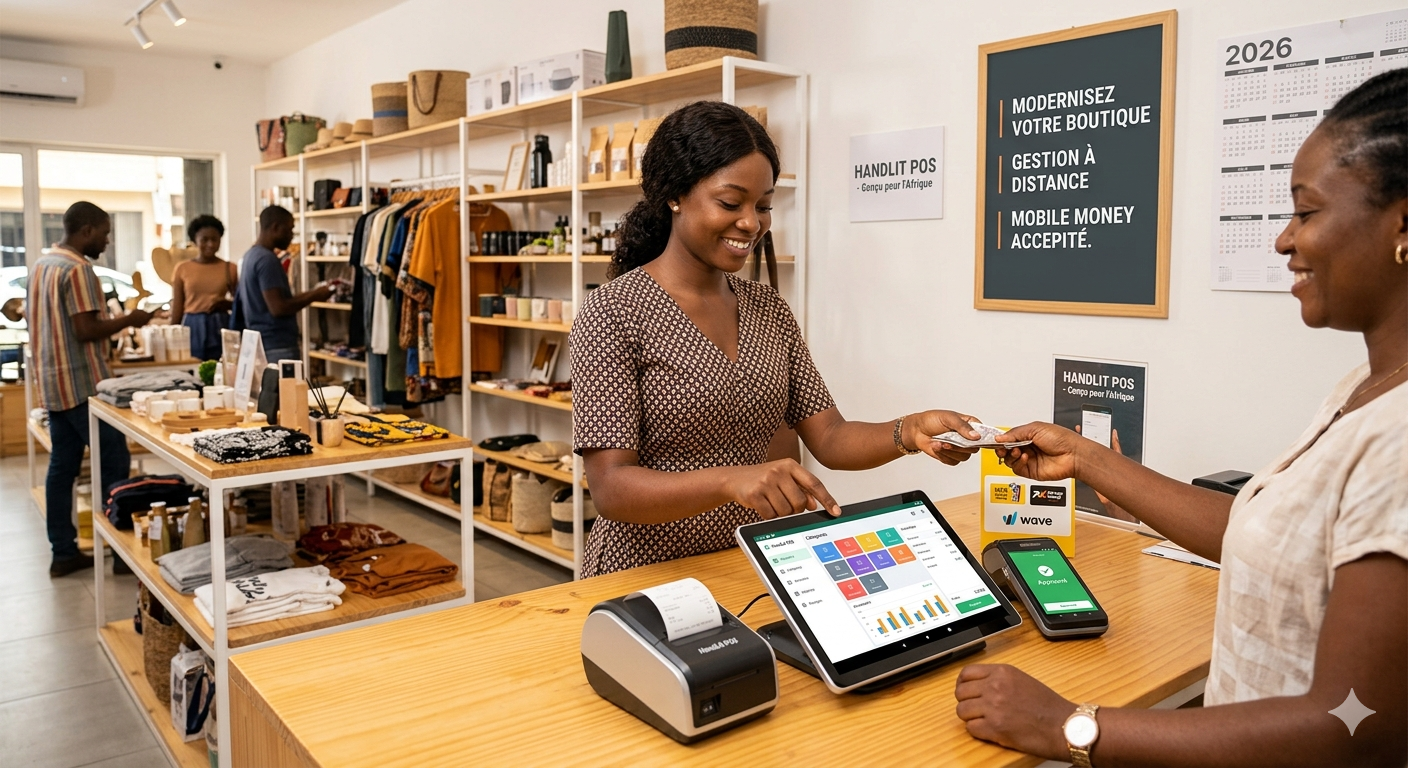
- Till and point of sale (POS): in-store payments, receipts, end-of-day closing
- Customer management: customer file, purchase history, receivables and reminders
- Supplier management: orders, supplier debts, due dates
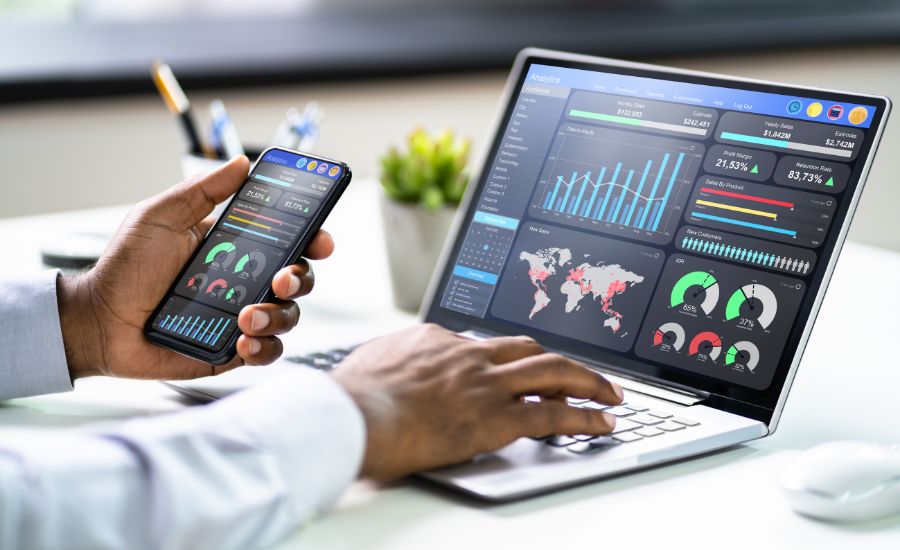
- Reporting: dashboards for revenue, margins and cash flow
The goal isn't to have "software to look modern". The goal is threefold: reduce errors and losses (stock theft, forgotten invoices, receivables never chased), save time on administrative tasks, and manage with reliable figures instead of navigating by instinct.
Why Cameroonian SMEs can no longer do without it in 2026
1. Tax and regulatory pressure is increasing
The Cameroonian tax administration is digitalising rapidly. E-filing on the DGI's Fiscalis portal has become the norm for companies under the real tax regime, monthly VAT returns are a strict obligation, and your invoices must include precise legal details (NIU, VAT rate, full identification).
Approximate invoicing opens the door to tax reassessments - one of the leading causes of difficulty for SMEs in Cameroon. Management software that generates compliant invoices automatically and produces the month's VAT summary in two clicks turns this constraint into a simple formality.
➡️ Also read: our page dedicated to DGI-compliant invoicing software in Cameroon.
2. Invisible losses kill margins
In a business run "from the notebook", leaks are everywhere: an item taken out of stock without being invoiced, a discount granted too generously by a salesperson, a customer who has owed 150,000 FCFA for four months and whom nobody has chased, a calculation error on a large invoice.
Individually, each leak seems small. Added up over a year, they often represent several million FCFA for a medium-sized SME. Management software makes these leaks visible: every stock movement is tracked, every receivable has a due date, every sale is linked to a salesperson.
3. You can't be everywhere
Many Cameroonian business owners run several points of sale, or travel regularly. Without a tool, you depend entirely on what your employees choose to report. With connected management software, you can check the day's sales, your till status and your stock in real time from your phone, whether you're in Douala, Yaoundé or abroad.
4. The competition is going digital
Your competitors are starting to equip themselves. A business that can produce a professional quote in 10 minutes, deliver without errors and follow up with customers at the right time automatically gains market share over one that does everything by hand.
The 4 main families of solutions available in Cameroon
Before comparing brands, understand the categories. That's the first filter for your choice.
Spreadsheets (Excel, Google Sheets)
This is the starting point for almost every SME, and it's better than nothing. But Excel quickly reaches its limits: no traceability (who changed what?), invisible formula errors, multiple files that don't talk to each other, no access rights management, and no way of running a till in real time. Excel is an analysis tool, not an operational management tool.
Who is it for? A business that's just starting, with very few transactions. Beyond a few dozen operations a day, you lose money by staying on Excel.
International software (Sage, QuickBooks, Odoo...)
These are powerful, proven solutions. Sage, in particular, is well established in Cameroon through local integrators, especially for SYSCOHADA accounting in structured companies.
Their limitations for a Cameroonian SME: a high cost (licences, integration, maintenance), complexity that requires training, features designed for Europe (no native Mobile Money, little tolerance for connection outages), and dependence on an integrator for the slightest change.
Who is it for? Medium-sized and large companies with a structured accounting department and a substantial budget.
Local and regional SaaS (online subscription)
A new generation of cloud solutions developed in Cameroon or for French-speaking Africa has emerged: examples include zBilling, CloudFacile, Optisales, GestionsPro and others. They work on a monthly subscription, are accessible from a browser, and generally integrate local realities better (FCFA, Cameroonian tax details).
Their strengths: a low entry cost, a quick start, no server to manage. Their limitations: you adapt to the software (not the other way round), some depend heavily on the internet connection, and if your business has specific needs (a particular approval workflow, complex pricing, unusual multi-depot management), you'll quickly feel constrained.
Who is it for? Micro-businesses and small shops with standard processes and an immediate need on a small budget.
Custom software
Here, the software is developed around the way you work, not the other way round. Your sales channels, your discount rules, your depots, your user roles, your reports: everything is designed for your business. It's also the only option that guarantees ownership of the tool and your data, and evolution at the pace of your growth.
The initial investment is higher than a SaaS subscription, but it pays for itself: no per-user subscription that grows with your team, no features paid for but unused, and a tool your employees adopt quickly because it speaks their business language.
Who is it for? Growing SMEs, businesses with specific processes (distribution, multiple shops, construction, services), and companies that want a lasting competitive advantage rather than a tool identical to their neighbour's.
➡️ Discover our approach to custom sales management software in Cameroon.
8 criteria for choosing the right management software in Cameroon
This is the heart of this guide. Assess each candidate solution on these 8 points, in this order.
Criterion 1: Cameroonian tax compliance
This is non-negotiable. The software must produce invoices with all the details required by the DGI (NIU, full company name, VAT detailed at the current rate), correctly handle output and input VAT, and let you easily produce the statements needed for your monthly returns on Fiscalis.
Question to ask the supplier: "Show me an invoice generated by your software. Does it comply with Cameroonian DGI requirements?" If the demo shows an invoice with a French SIRET number or 20% VAT, run: the software hasn't been adapted to Cameroon.
Criterion 2: offline operation
Power and internet outages are part of daily life. If your till software stops when the connection drops, your shop stops too - and your salespeople bring the notebook back out, which destroys the reliability of your data.
Choose an offline-first solution: it works locally and syncs automatically as soon as the connection returns. It's one of the most decisive criteria between software designed for Europe and software designed for Cameroonian conditions.
Criterion 3: integration of local payments (Mobile Money)
In Cameroon, a huge share of payments goes through MTN Mobile Money and Orange Money. At a minimum, your software must let you record a MoMo/OM payment as a separate payment method (to reconcile your till), and ideally connect with these services to automate payment confirmation.
Software that only knows "cash, cheque, bank card" wasn't designed for your market.
Criterion 4: simplicity for your teams
The best software in the world is useless if your salespeople don't use it. Your field teams aren't IT specialists: the interface must be simple, in French, usable on an entry-level Android smartphone, and a sale must be recorded in a few seconds.
A practical test: ask for a demo and have your least tech-savvy employee try the tool. If they manage in 15 minutes, that's a good sign.
Criterion 5: real functional coverage of YOUR business
Write down your 10 most important daily operations (e.g. counter sale, credit sale, receiving goods, transfer between depots, till closing, customer reminder...). Then check, in a demo, that the software handles each of them without patchwork. Software that covers 80% of your needs will force you into permanent workarounds for the remaining 20% - and that's where errors creep back in.
Criterion 6: local support and assistance
When your till freezes on a Saturday at 6 pm, email support in Europe won't save you. Check: can the supplier be reached by phone or WhatsApp? Can they come on site in Douala or Yaoundé? Do they offer training for your teams at start-up? Is support included or billed per intervention?
The supplier's proximity is often more decisive than the feature list.
Criterion 7: security and ownership of your data
Your sales data, margins and customer file are strategic. Ask these questions: where is the data hosted? Who has access to it? What happens if I cancel: can I get all my data back in a usable format? Are there automatic backups?
With a SaaS, you rent access to your own data; with custom software, you own it. Both models are viable, but know what you're signing.
Criterion 8: total cost over 3 years (not the displayed price)
Compare the total cost of ownership over 3 years, not the entry price:
- SaaS: monthly subscription × number of users × 36 months + set-up fees + additional modules
- International software: licences + integration + annual maintenance + training
- Custom: initial development + annual maintenance/improvements
A subscription at 25,000 FCFA/month looks unbeatable, but with 5 users over 3 years, plus the "premium" modules that have become essential, the bill often exceeds the cost of custom development - without owning the tool at the end.
How much does management software cost in Cameroon? Orders of magnitude
Prices vary widely depending on scope, but here are realistic benchmarks for 2026:
| Type of solution | Entry cost | Recurring cost | Ideal for |
|---|---|---|---|
| Spreadsheet (Excel) | Almost zero | Lost time and errors | Starting a business |
| Local/regional SaaS | 0 to 100,000 FCFA | 10,000 to 60,000 FCFA/month depending on modules and users | Micro-businesses, standard processes |
| Integrated international software | 1 to several million FCFA | Significant annual maintenance | Structured companies |
| Custom software | A few hundred thousand to a few million FCFA depending on scope | Moderate annual maintenance | Growing SMEs, specific needs |
The right approach isn't to look for the cheapest option, but to weigh the cost against your current losses: if approximate management costs you 200,000 FCFA a month in leaks, errors and lost time (an often conservative estimate), your software pays for itself in a few months.
5 classic mistakes to avoid
Mistake 1: choosing software because it's free. Free versions are loss leaders: limits on users and invoices, no support. You'll migrate in 6 months, losing time and sometimes data.
Mistake 2: buying before writing down your needs. Without a clear list of your daily operations, the supplier's salesperson defines your needs for you.
Mistake 3: ignoring your teams. A tool imposed from above without training or user involvement ends up abandoned, and the notebook comes back. Involve your cashier or storekeeper from the demo onwards.
Mistake 4: trying to digitalise everything at once. Start with the module that's bleeding the most (often invoicing or stock), stabilise it, then expand. Successful digitalisation is gradual.
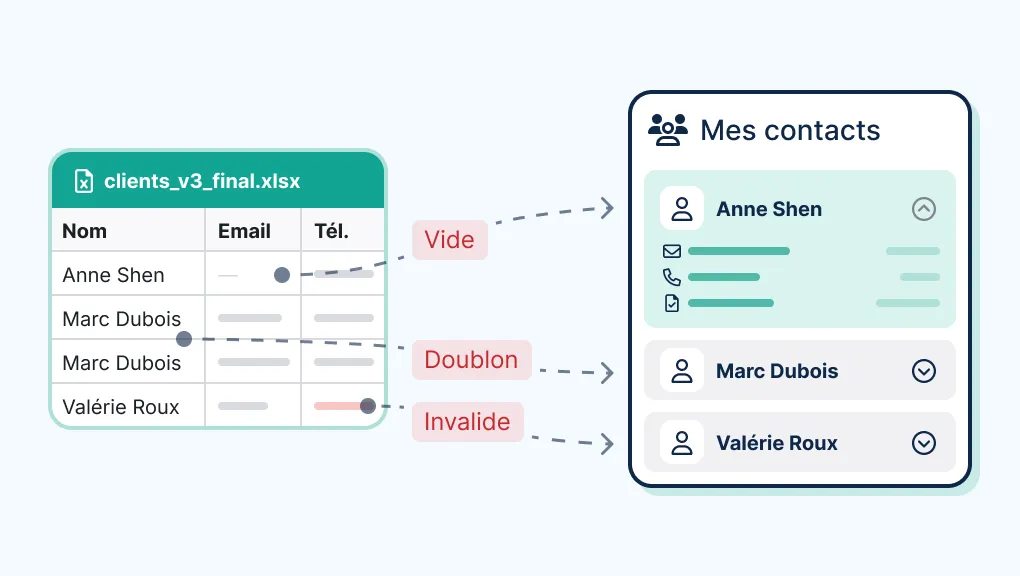
Mistake 5: neglecting data migration. Your items, customers and stock balances must be properly transferred to the new tool. Clarify who does this work, how and at what cost, before signing.
How to succeed with implementation: the 5-step method
- Define your needs (1 week): list your operations, pain points, users and their roles.
- Compare 2 or 3 solutions using the 8 criteria above, with demos, having your teams test them.
- Start with a pilot scope: one point of sale, or one module (e.g. invoicing + stock).
- Train and support: half a day of training per user profile, simple guides and an in-house point person.
- Expand and optimise: add the next modules (till, suppliers, reporting) once the foundation has been adopted.
At Alivaon, that's exactly the approach we follow with the businesses we support in Douala and across Cameroon: needs analysis, agile development, team training, then long-term support and improvements.
FAQ: your questions about management software in Cameroon
Do you need a permanent internet connection? No, provided you choose a solution designed to work offline (offline-first), which syncs your data as soon as the connection returns. It's an essential criterion in Cameroon.
Does management software replace my accountant? No, it makes their life easier. The software produces clean data (sales, purchases, VAT) that your accountant uses for your returns and your DSF (annual tax return). You both save time, and you reduce the risk of tax errors.
Can I manage several shops with a single piece of software? Yes, it's actually one of the biggest benefits: stock per depot, tracked transfers, separate tills, and a consolidated dashboard for the manager.
How long does implementation take? From a few days for a simple SaaS to a few weeks for custom software covering invoicing, stock and the till, training included.
Is my data secure? More so than in a notebook or an Excel file on a single computer. Insist on automatic backups, per-user access with passwords, and the ability to export your data at any time.
In summary: the checklist for the right choice
Before signing, check that your future management software:
- ✅ Produces DGI-compliant invoices (NIU, VAT) and makes your returns easier
- ✅ Works offline and survives outages
- ✅ Handles Mobile Money payments (MTN MoMo, Orange Money)
- ✅ Is simple for your field teams to use, on Android
- ✅ Covers your 10 daily operations without patchwork
- ✅ Comes with responsive local support and real training
- ✅ Guarantees the security and recovery of your data
- ✅ Remains cost-effective over 3 years, not just the first month
What's next?
The right management software isn't an expense: it's the investment that secures your margins, makes your figures reliable and frees up your time as a manager. The wrong choice costs you twice: the price of the tool, and the cost of migrating when you have to change it.
Want an honest opinion on your situation? Alivaon, a digital agency based in Douala, designs sales management, invoicing, stock management and till/POS software adapted to the realities of Cameroonian businesses.

Be the first to leave a comment.