

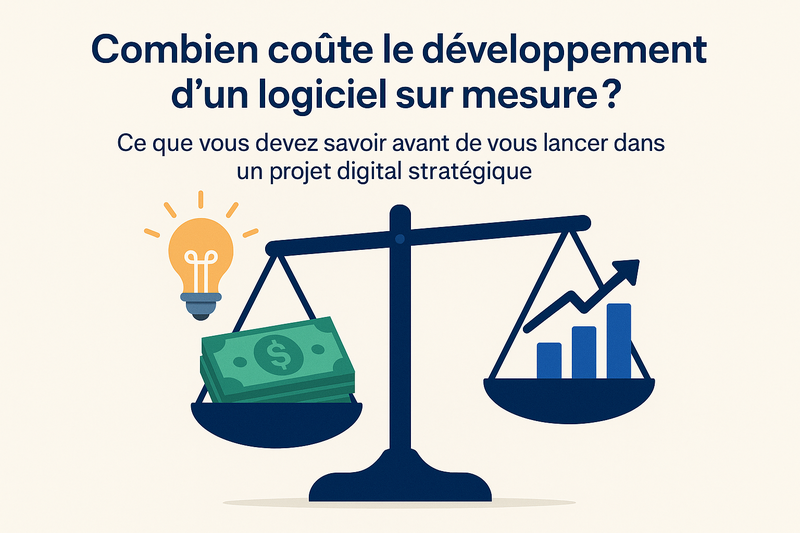
It's the question every Cameroonian business owner asks when digitalising their management: should you take "ready-to-use" software on a subscription, or have a custom tool developed for your business?
SaaS vendors will tell you custom software is expensive and slow. Developers will tell you standard software will lock you in. Both are partly right - and that's exactly the problem.
This article gives you an honest, structured answer: what each option really costs, what it brings you, when it's the right choice, and a 7-question decision grid to decide in under 30 minutes. Spoiler: there's no universal right answer, but there is a right answer for your business.
This article is part of our series on management software: if you're starting from scratch, first read the complete guide to choosing well in 2026, and to find out which solutions are available, see our comparison of the 7 best sales management software in Cameroon.
What exactly are we talking about?
Standard software
Standard software is a finished product, identical for all its customers, that you use as is or with limited configuration. In Cameroon, this category includes:
- Subscription SaaS (zBilling, CloudFacile, GestionsPro, Mobility Cloud...): you pay every month, access it online, and the vendor hosts everything.
- Integrated software (Sage 100, Odoo...): more powerful, installed and configured by an integrator, with licences and maintenance.
- Generic tools (Excel, Wave...): the default solution for most SMEs, with their well-known limitations.
The principle is the same everywhere: the vendor has defined a way of working, and your business adapts to the software.
Custom software
Custom software is developed specifically for your business, based on your real processes: your sales channels, your discount rules, your depots, your internal approvals, your reports. Here, the software adapts to your business. You own the tool, and it evolves according to your decisions, not a vendor's roadmap.
Between the two, there's a grey area: "customised" standard software (Odoo with custom-developed modules, a SaaS with dedicated options). We'll come back to it, because it's sometimes the best compromise - and sometimes the worst of both worlds.
The match in 7 rounds
Round 1: upfront cost - advantage standard
No debate here. A local SaaS starts at 10,000 to 60,000 FCFA a month, often with a free trial. Custom development represents an initial investment of several hundred thousand to several million FCFA depending on the scope.
If your cash flow is tight and your need is urgent, standard wins this round hands down. But upfront cost is only part of the story - that's the classic trap of this comparison.
Round 2: total cost over 3 to 5 years - a draw, it depends on you
Let's do the calculation nobody does before signing. Take an SME with 6 users on a SaaS at 20,000 FCFA excl. VAT/month for 5 users, which will need to move up to a higher plan:
- Subscription: say 30,000 to 50,000 FCFA/month with extra users and modules
- Over 4 years: between 1.4 and 2.4 million FCFA - without owning the tool at the end, and without counting workarounds (parallel Excel files, double entry) that cost staff time every week.
Custom software with an equivalent scope, amortised over the same period with moderate annual maintenance, often lands in the same cost range - but you own the tool, it covers 100% of your processes, and it doesn't cost more when you hire.
The real rule: the bigger your team and the longer you plan to keep the tool, the more competitive custom software becomes. For 2 users over 18 months, SaaS is unbeatable. For 10 users over 5 years, the calculation is frequently reversed.
Round 3: time to go live - advantage standard
A SaaS is deployed in a few days: account creation, importing items and customers, a short training session. Custom software requires scoping, development and testing: allow several weeks, sometimes a few months for a broad scope.
If you need to invoice properly by Monday, standard is the only rational answer. A common and healthy strategy: start on a SaaS to stabilise the basics, and switch to custom software when the limitations become costly.
Round 4: coverage of YOUR processes - advantage custom
This is the heart of the matter. Standard software covers... standard processes well. Yet many Cameroonian SMEs have specific features that are precisely what makes them strong: credit sales with payment schedules negotiated customer by customer, delivery rounds with field collection, different prices depending on the channel (retail, semi-wholesale, wholesale), several depots with transfers, sales commissions calculated using in-house rules, manager approval above a certain amount...
With standard software, every specific need that isn't covered becomes a workaround: an Excel file on the side, a rule kept "in your head", double entry. And every workaround reintroduces exactly the errors and leaks the software was supposed to eliminate. Custom software, on the other hand, is built around these specific needs: that's its reason for being.
A simple test: list your 10 critical daily operations. If a standard tool covers 9 or 10 natively, go standard. If it covers 6 or 7, the workarounds will cost you more than the development.
Round 5: adaptation to Cameroonian conditions - advantage custom (with nuances)
Power and internet outages, Mobile Money payments (MTN MoMo, Orange Money), field teams on entry-level Android phones, DGI-compliant invoicing with NIU and VAT: these are the basic requirements of the Cameroonian market.
Locally developed SaaS (zBilling, CloudFacile...) handle FCFA and tax details well - that's their advantage over European solutions. But real offline mode (a till that keeps taking payments during an outage and syncs when the connection returns) remains the weak point of most cloud solutions. Custom software designed offline-first handles this scenario at the architecture level, because it was defined with you as the number one requirement.
Round 6: evolving over time - advantage custom
With standard software, your change requests join every other customer's wish list: if the vendor deems the feature profitable, it will arrive... someday. With custom software, your tool follows your strategy: new point of sale, new product range, new distribution channel - the tool evolves when you decide, at the pace of your growth.
The trade-off: this evolution has a cost (development days) and requires a reliable long-term provider. Hence the importance of the next round.
Round 7: dependence on the supplier - a draw, but not the same risk
Custom software is often accused of creating dependence on the developer. That's true if the project is poorly contracted. But dependence also exists - differently - with standard software: if your SaaS raises its prices, removes a feature or shuts down, you have no say. Your data is on their side; always check the export conditions.
In both cases, the protections are contractual. For custom software, insist on: ownership of the source code (or at least a source code escrow), technical documentation, a maintenance contract with response times, and reversibility (another provider must be able to take over the project). For standard software: full export of your data at any time in a usable format, and a careful reading of the termination conditions. A provider or vendor who refuses these clauses is telling you something important about themselves.
The grey area: customised standard software
A third way: start from a standard base (often open source, such as Odoo or Dolibarr) and have it customised by an integrator. On paper, it's appealing: a proven foundation + business-specific adaptations.
In practice, this model works well when customisations remain light (reports, fields, documents). It becomes a trap when they are heavy: every upgrade of the base risks breaking your specific developments, and you end up combining the costs of standard software (licences or maintenance of the base) and those of custom software (developments to maintain). If more than 30 to 40% of your needs require specific development, true custom software is generally healthier and more economical in the long run.
The decision grid: 7 questions to decide
Answer honestly and count your points.
- Are your processes standard (simple counter sales, conventional invoicing, a single point of sale)? Yes = 1 point Standard. No = 1 point Custom.
- Do you need to be operational in less than 2 weeks? Yes = Standard. No = Custom.
- Will your team exceed 5 users within 2 years? Yes = Custom. No = Standard.
- Do you already maintain more than 2 Excel files alongside an existing tool (or do you foresee cases that the tools shown in demos can't handle)? Yes = Custom. No = Standard.
- Does your business depend on reliable offline operation (point of sale, field sales)? Yes = Custom (or a standard tool whose offline mode has been tested in real conditions). No = Standard.
- Does your budget allow for an upfront investment (vs only a monthly subscription)? Yes = Custom possible. No = Standard.
- Is your way of working a competitive advantage that you want to strengthen rather than standardise? Yes = Custom. No = Standard.
5 points or more on one side: your answer is clear. Close score (4-3): start with a local SaaS for the most urgent module, and plan the switch to custom software in 12 to 18 months - you'll then have a golden specification, shaped by real-world use.
Three real-world cases to help you position yourself
Case 1 - The clothing shop in Akwa (2 employees). Counter sales, one stock, simple invoicing. Verdict: standard, without hesitation. A local SaaS at 10,000–20,000 FCFA/month does the job perfectly. Custom software would be an unnecessary luxury at this stage.
Case 2 - The beverage distributor in Douala (3 depots, 8 field sales reps, credit sales). Rounds with offline payment collection, negotiated customer payment schedules, daily inter-depot transfers, commissions based on in-house rules. Verdict: custom. No standard tool covers this flow without massive workarounds, and every workaround at this volume costs millions a year.
Case 3 - The B2B services firm in Yaoundé (5 people), which already invoices on a SaaS but manages its projects in 4 Excel files. Verdict: transition. The SaaS stays for invoicing; a custom project/time management module, connected to the existing system, eliminates the Excel files. Custom software isn't all or nothing: it can complement a standard tool.
4 pitfalls to avoid, whatever you choose
- Choosing custom software without a specification. Development launched on vague needs produces a vague tool. Insist on a written scoping phase before any fixed quote.
- Choosing standard software based on the salesperson's demo. Impose YOUR real cases in the demo, with your actual products and your actual sales scenarios. That's where the limitations show up.
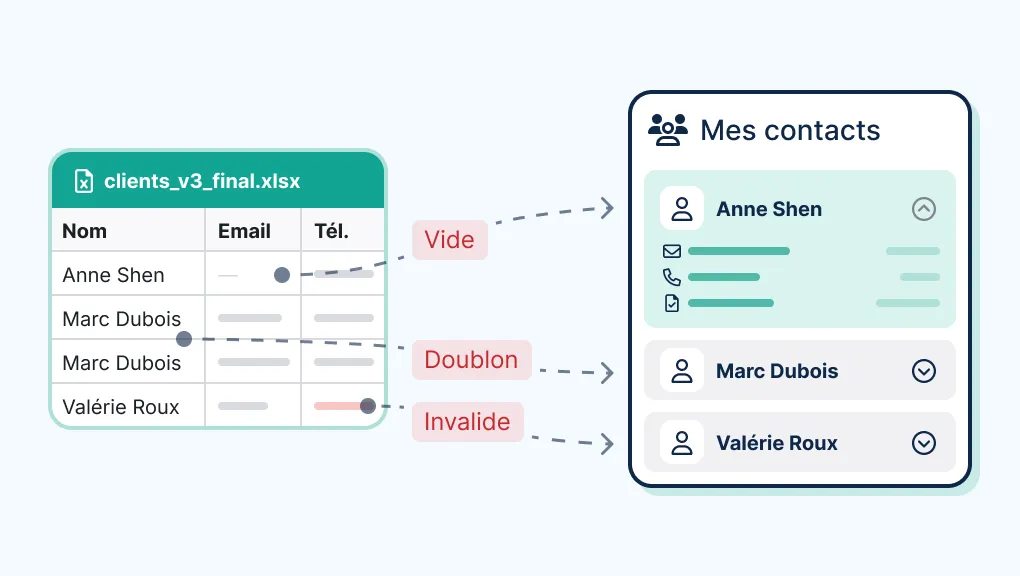
- Forgetting data migration. Items, customers, balances: who migrates what, how, and at what cost? Clarify this before signing, in both models.
- Neglecting the contract. Data export (standard) or code ownership and maintenance (custom): everything is negotiated beforehand, nothing afterwards.
FAQ
How much does custom software cost in Cameroon? It depends on the scope: a targeted module (invoicing + stock) costs hundreds of thousands of FCFA, a complete multi-depot solution a few million. The right approach is to compare this amount with the cumulative cost of a subscription over 3 to 5 years, plus the cost of your current workarounds.
Is custom software risky if the developer disappears? Not if the contract provides for ownership of the source code, documentation and reversibility. That's the first thing to require from a provider - and a serious provider offers it of their own accord.
Can you start with standard software and then move to custom? Yes, it's actually an excellent path: standard software stabilises your practices and reveals your real needs; custom software then builds on that. Just make sure your data will be exportable.
Can custom software be DGI-compliant and handle Mobile Money? That's precisely its advantage: Cameroonian tax compliance (NIU, VAT) and MTN MoMo / Orange Money integration are defined as requirements from the design stage, instead of being options to check.
What is the lifespan of custom software? With regular maintenance, 7 to 10 years or more. It's over this period that the initial investment reveals its full profitability compared with cumulative subscriptions.
Our final advice
Standard software is the right default choice when your needs are simple, urgent and... standard. Custom software is the right choice when your processes are your strength, your team is growing, and workarounds are already costing you more than you think.
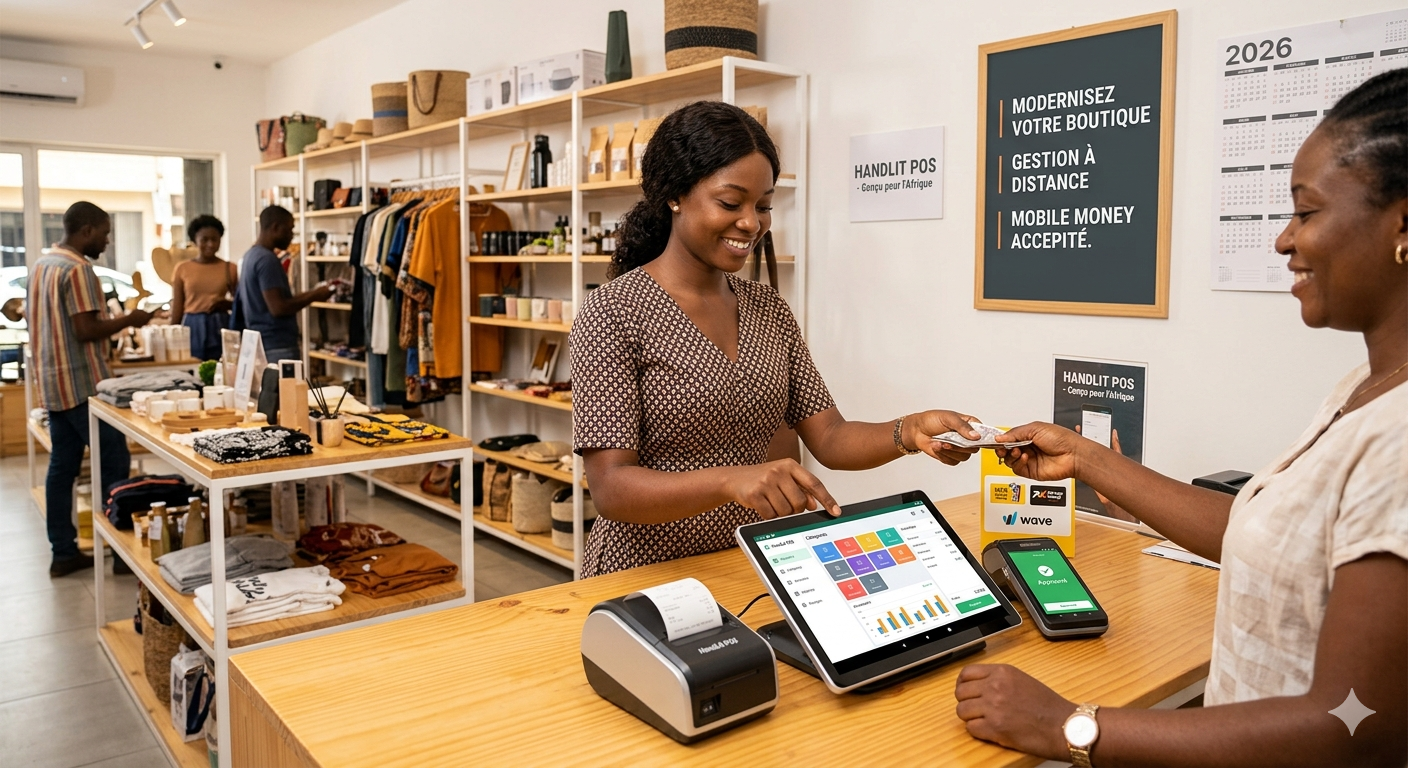
And if you're still unsure, your situation probably deserves a diagnosis, not a slogan. At Alivaon, we do both exercises with you: analysis of your processes, an honest costing of both scenarios over 3 years - and if standard software is enough for you, we'll tell you. If custom software is justified, we design your sales management software, your DGI-compliant invoicing, your stock management or your till/POS - designed for offline use and Mobile Money from the start.



Be the first to leave a comment.